
You Don’t Have to Navigate This Alone: Approaching Career Decisions More Intentionally
There is an implicit expectation in early career development that people should be able to figure things out independently. How to find placements, evaluate roles, and make decisions about what comes next are often treated as individual responsibilities. In practice, these decisions are complex and carry real professional and ethical implications. They involve questions about scope of practice, fit, long-term direction, and the kind of professional you are becoming.
Those are not decisions that benefit from isolation.
Across training and early career stages, it is common to see thoughtful and capable individuals navigating high-impact decisions without a clear structure for working through them. This is not a question of motivation or ability. It reflects how little structured time and support is built into professional development for evaluating options, discussing uncertainty, and making career decisions with intention.
Career Development Is Not Linear, and Not Fully Taught
We recently wrote about the idea that you do not have to remain in clinical work if it no longer aligns. That is true. People shift directions, specialize, or move into adjacent roles across the lifespan of their careers.
What tends to differentiate sustainable transitions from reactive ones is not confidence or decisiveness. It is the process.
Thoughtful career movement usually involves:
clarifying personal values,
examining what different roles actually entail, and
making decisions that align with both ethical practice and long-term direction.
It SHOULD also involve consultation, discussion, and feedback. Not because individuals cannot make decisions independently, but because different perspectives are necessary when navigating unfamiliar or ambiguous options.
One of the core ideas we emphasize in this work is that there is no single correct path, but there are more intentional ways of building one.
Graduate training plays an essential role in developing foundational knowledge, analytic thinking, and professional identity. At the same time, many programs are designed with an academic or research-oriented structure, meeting test content outline requirements, or accreditation standards, even when students ultimately pursue applied roles.
As a result, there can be a gap between what is emphasized during training and what is required to navigate real-world career decisions. Areas such as evaluating job fit, identifying ethical concerns in workplace settings, understanding role boundaries, and translating experience into professional language are not always addressed in a systematic way.
This is not a limitation of training itself. It reflects the reality that there are multiple professional paths, and not all of them can be fully addressed within a single curriculum.
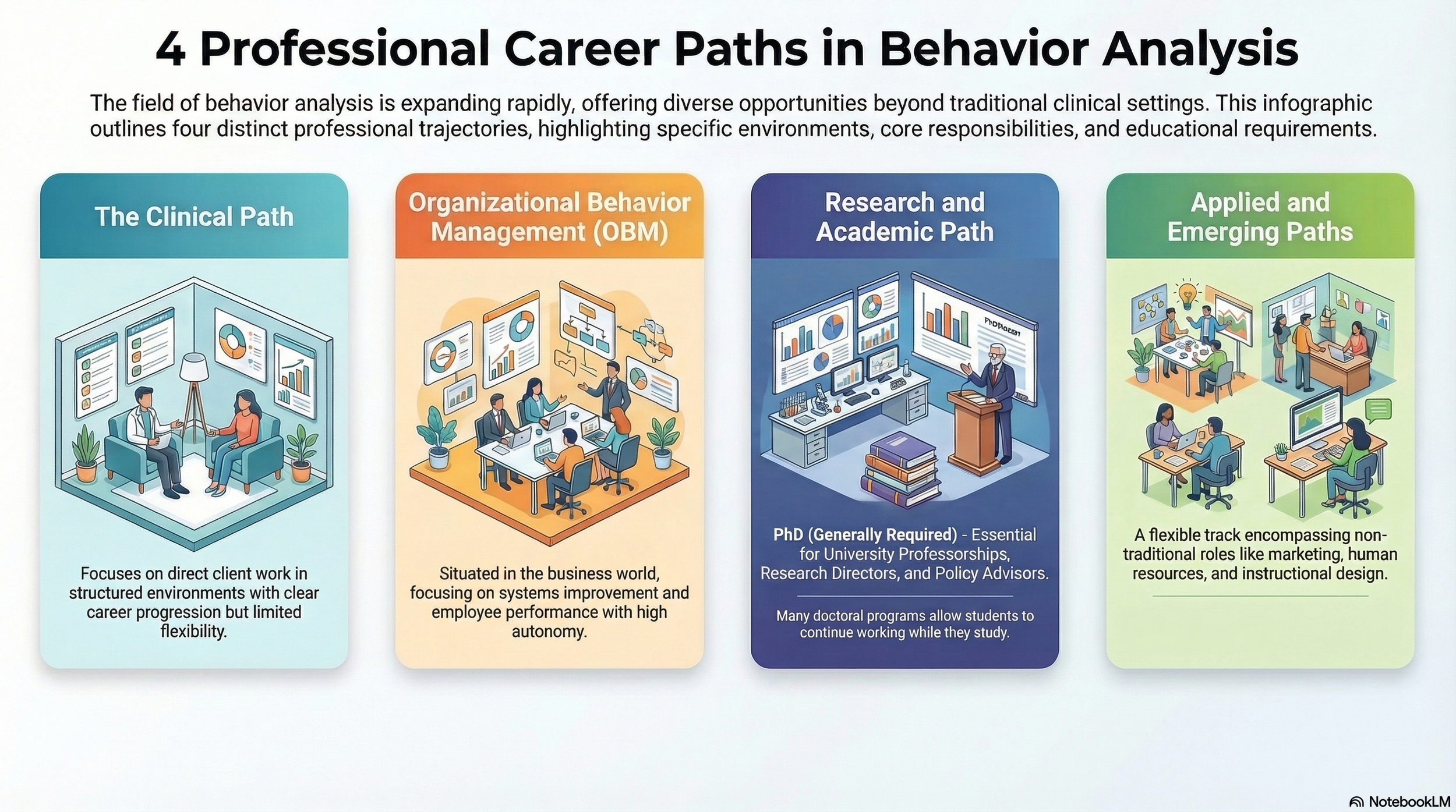
A graphic detailing 4 professional career paths in behavior analysis: clinical work, OBM, research/ academia, and applied and emerging paths.
Early roles and placements are often presented in ways that obscure important differences. Job descriptions can be vague or aspirational. Expectations around responsibilities, supervision, and boundaries are not always explicit. Two roles with similar titles can differ significantly in what is actually required or appropriate.
At the same time, many individuals are trying to translate academic, practicum, or early experience into professional language without much guidance. They are making decisions about fit without clear criteria, or trying to determine whether something is a good opportunity without a framework for evaluating it. In combination, these factors complicate the process of evaluating opportunities and making informed decisions.
A More Realistic and Structured Approach to Professional Decision-Making
It is entirely reasonable not to have a clear or linear path at this stage. What is less consistent with best practice is the expectation that individuals should navigate these decisions without input, reflection, or structure.
Learning how to evaluate opportunities, clarify boundaries, and make informed decisions is part of professional development. Like other aspects of training, it tends to be more effective when it happens in a context that allows for discussion and guidance.
You do not have to approach that process alone.
The Professional Foundations group was developed to address this gap. It is not designed to provide answers or direct outcomes. Instead, it creates a structured environment where participants can think more clearly about their decisions and the implications of those decisions.
Within that space, we examine how to approach opportunities in a way that is both strategic, ethically grounded, and values-driven. This includes reading job postings beyond surface descriptions, assessing alignment with personal values and scope of practice, and communicating professionally in a way that reflects appropriate boundaries. There is also a strong emphasis on translating experience into language that is accurate, specific, and professionally meaningful, along with learning through discussion with others who are navigating similar questions.
The intention is not to accelerate decision-making, but to improve its quality.
Taking the time to engage in this work within a structured environment matters. Without intentionally setting aside space to reflect, discuss, and evaluate options, career decisions are more likely to become reactive, shaped by urgency, external pressure, or limited information. Structure creates the conditions for deeper thinking, more informed choices, and accountability to the kind of professional you are working toward becoming. It allows for pause, perspective, and the integration of feedback in ways that are difficult to replicate independently. Investing in that process is not an extra step. It is a critical part of making decisions that are sustainable, ethical, and aligned over time.
If you would like to learn more about the Professional Foundations group, additional information is available by following this LINK or reaching out to Shauna Costello.