
Reframing Procrastination
Let’s be honest, we all procrastinate. As much as we don’t want to, as much as we think we get things done in a timely manner… Procrastination creeps in. We clean right before guests come over. We finish the paper just before the due date. We wait until the last minute before finalizing the presentation. It happens, and we need to remove the shame around it.
If you’re a behavior analyst (or aspiring behavior analyst), this graph may look familiar to you. It shows the behavior produced by a fixed interval schedule of reinforcement. This pattern is also called scalloped responding. Responding picks up just before reinforcement is delivered, creating the scalloped pattern on the graph.
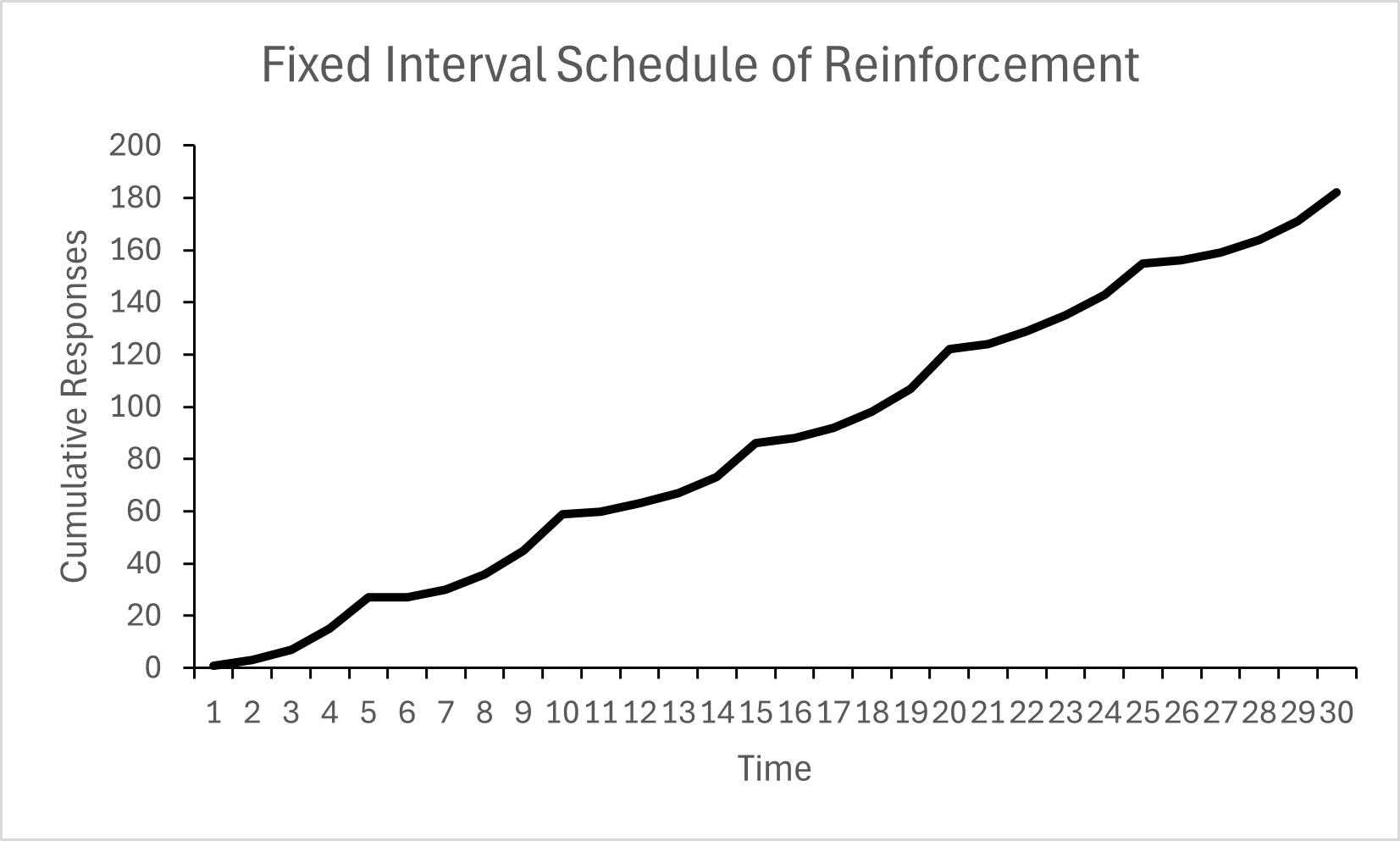
The points on the graph are where reinforcement is delivered. We can see that immediately after delivering reinforcement, responding stops for a bit. It picks up again before reinforcement is to be delivered. This makes sense, right? No one wants to walk out of a quiz and immediately begin studying. We aren’t about to start cooking right after eating a meal. After we receive reinforcement, there is a post-reinforcement pause.
How do these things create procrastination? Well, when a task is not reinforcing to complete, we are often working with negative reinforcement. We want to avoid the negative consequences associated with missing a deadline, but we aren’t receiving other reinforcement for completing the task. Why would we get work done early when the reinforcement (avoiding missing a deadline) is only available at one particular time? This creates the scallop where responding speeds up just before the deadline.
We will also see a post-reinforcement pause. Depending on the context, responding may or may not entirely stop (you might lose your job if you stop coming to work after completing a report), but it will definitely slow down after reinforcement is delivered. Why work as hard as possible when reinforcement is temporarily unavailable? This only makes sense.
You’re not procrastinating, you’re engaging in scalloped responding.
Strategies to Mitigate Procrastination
Change Reinforcement
Now that we have reframed procrastination as scalloped responding, how do we mitigate this? The first thing will be to attach reinforcement to the response you want to see. Currently, you are operating under negative reinforcement, where your motivation to complete the task is simply to avoid the negatives created by missing a deadline. We need to create some positive reinforcement for completing the task. If you only get to watch your favorite show after you have worked on a project, or you get a special treat after every 200 words you write, we will start to see your behavior change.
Increase Reinforcement
We also need to pay attention to the schedule of reinforcement. If reinforcement is too delayed, responding will remain low until the deadline approaches. Increasing the frequency of reinforcement reduces the size of the scallop. Keeping with the TV show example, if new episodes come out once a week, but you need to work on the project daily, these schedules don’t match up. You need reinforcement that is available as often as you complete the goal.
Manipulate the Environment
We are always responding under concurrent schedules of reinforcement; there is almost always something else we could be doing. When we want to increase productivity and start working on a project, paper, or other task, there are environmental manipulations we can do to change the concurrent schedules of reinforcement. This can look like putting your phone in the other room or turning on a study playlist (personally, I turn on piano music when I really need to focus). These suggestions work by making it harder to get distracted (putting your phone away) or by making the productive environment more satisfying.
Closing Thoughts
Procrastination is not a moral failure; it’s a result of the schedule of reinforcement. Don’t waste time asking “why am I like this?” Instead, evaluate the contingencies in your environment and watch your behavior change.
